Indian Working Class with 4 New Labour Code: The 2026 Comprehensive Guide
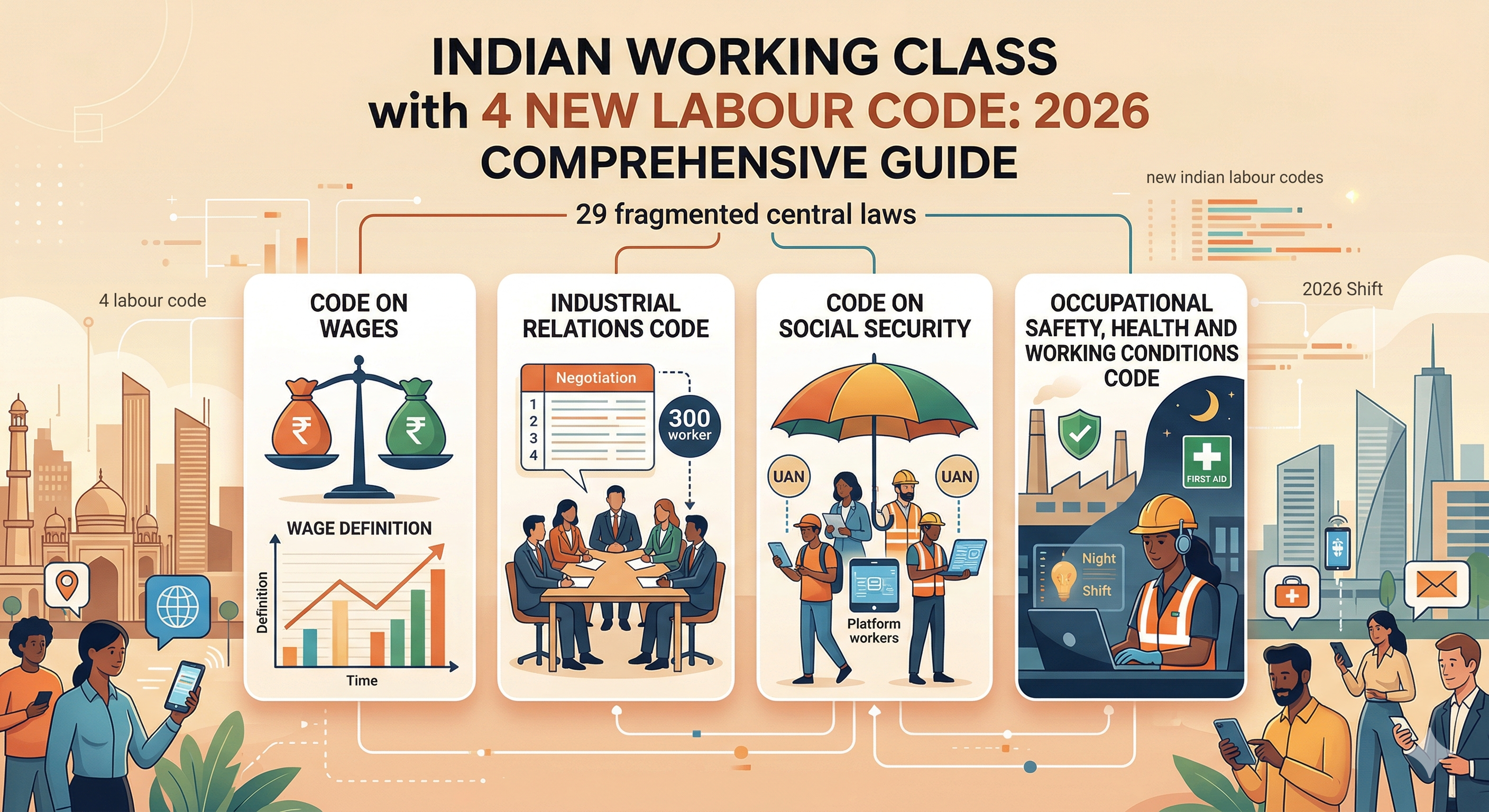
The landscape of employment in India has undergone its most significant transformation since independence. As of November 21, 2025, the Government of India officially implemented the 4 new labour codes, consolidating 29 fragmented central laws into a unified framework.
For the Indian working class, this isn't just a legal update—it’s a complete "rewiring" of the employer-employee relationship. Whether you are a corporate professional, a factory worker, or a delivery partner, the new indian labour codes change how you get paid, how you work, and how you retire.
The Architecture of Reform: Decoding the 4 Labour Code
The transition from colonial-era regulations to the four labour code system aims to minimize "compliance drag" while theoretically extending the social safety net to the informal sector.
1. Code on Wages, 2019
This code absorbs the Minimum Wages Act and the Payment of Bonus Act.
- Universal Floor Wage: The Central Government now sets a "Floor Wage." No State Government can fix a minimum wage lower than this baseline, ensuring a dignified standard of living across borders.
- The 50% Rule: It mandates that "Basic Pay" must constitute 50% of the total salary (CTC), preventing companies from hiding wages under tax-saving allowances to avoid PF contributions.
2. Industrial Relations Code, 2020
This is the most debated pillar of the 4 new labour codes.
- The 300-Worker Threshold: Establishments with up to 300 workers can now conduct layoffs or closures without prior government approval.
- Negotiating Power: Only a union with at least 51% membership is recognized as the "Sole Negotiating Union," aimed at reducing inter-union rivalry but criticized for silencing smaller voices.
3. Code on Social Security, 2020
This code represents the "Safety Net" for the Social Security Code 2026 digital economy.
- Gig & Platform Recognition: For the first time, the new indian labour codes legally recognize gig workers (Zomato/Swiggy) and platform workers (Uber/Ola), granting them access to maternity benefits, insurance, and old-age protection.
- Universal Account Number (UAN): Aadhaar-linked UAN portability ensures that your PF and pension follow you from one job to the next, regardless of the state.
4. Occupational Safety, Health and Working Conditions (OSH) Code, 2020
- Night Shifts for Women: Women are now legally permitted to work night shifts (7 PM to 6 AM) in all sectors, provided employers ensure mandatory safety, transport, and consent.
- Free Health Check-ups: Employers are now required to provide annual health examinations for workers above the age of 45.
The 2026 Ground Reality: Why the "Antigravity" Shift Matters
For the Indian working class with 4 new labour code implementation, the impact is felt in the "Mathematics of the Paycheck."
The Wealth Accumulation Logic
Under the four labour code structure, your take-home pay might see a minor dip (3-5%), but your Provident Fund (PF) and Gratuity contributions skyrocket. This is a "forced-wealth" model.
Scientific Insight: By increasing the basic pay component, the codes ensure that the employer’s contribution to your retirement is calculated on a larger sum. By 2035, a worker under this code will have a retirement corpus nearly 30% larger than one under the old laws.
Fixed-Term Employment (FTE) & Gratuity
Previously, you needed 5 years of service for gratuity. Now, under Fixed-Term Employment, if you are hired for a 1-year contract, you are entitled to pro-rata gratuity. This provides much-needed "antigravity" to the careers of short-term and contract workers.
Subscribe to the newsletter
Get the latest posts delivered right to your inbox.